Class No.22  Data Structures http://ecomputernotes.com
Deletion in AVL Tree There are 5 cases to consider. Let us go through the cases graphically and determine what action to take. We will not develop the C++ code for deleteNode in AVL tree. This will be left as an exercise. http://ecomputernotes.com
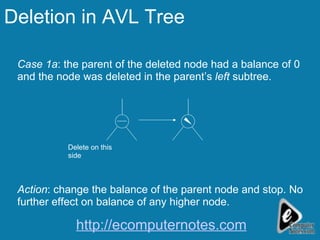
Deletion in AVL Tree Case 1a : the parent of the deleted node had a balance of 0 and the node was deleted in the parent’s  left  subtree. Action : change the balance of the parent node and stop. No further effect on balance of any higher node. Delete on this side http://ecomputernotes.com
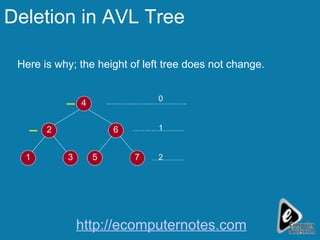
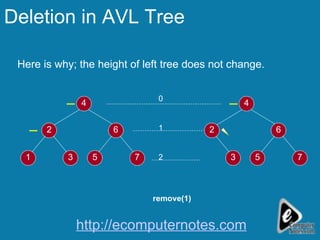
Deletion in AVL Tree Here is why; the height of left tree does not change. 1 2 3 4 5 6 7 0 1 2 http://ecomputernotes.com
Deletion in AVL Tree Here is why; the height of left tree does not change. 1 2 3 4 5 6 7 2 3 4 5 6 7 0 1 2 remove(1) http://ecomputernotes.com
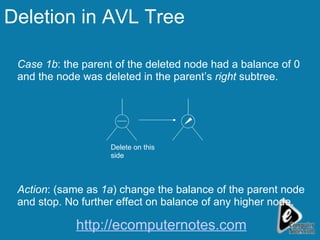
Deletion in AVL Tree Case 1b : the parent of the deleted node had a balance of 0 and the node was deleted in the parent’s  right  subtree. Action : (same as  1a )   change the balance of the parent node and stop. No further effect on balance of any higher node. Delete on this side http://ecomputernotes.com
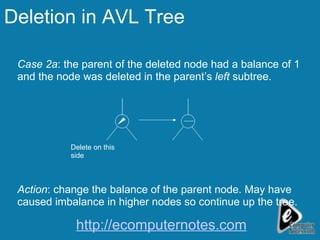
Deletion in AVL Tree Case 2a : the parent of the deleted node had a balance of 1 and the node was deleted in the parent’s  left  subtree. Action : change the balance of the parent node. May have caused imbalance in higher nodes so continue up the tree. Delete on this side http://ecomputernotes.com
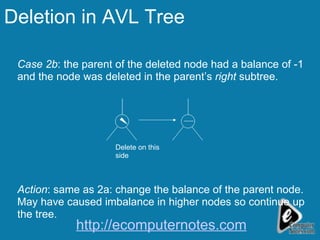
Deletion in AVL Tree Case 2b : the parent of the deleted node had a balance of -1 and the node was deleted in the parent’s  right  subtree. Action : same as 2a: change the balance of the parent node. May have caused imbalance in higher nodes so continue up the tree. Delete on this side http://ecomputernotes.com
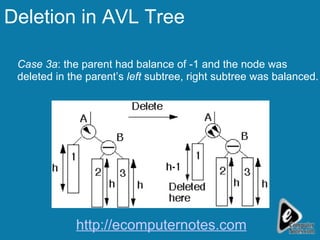
Deletion in AVL Tree Case 3a : the parent had balance of -1 and the node was deleted in the parent’s  left  subtree, right subtree was balanced. http://ecomputernotes.com
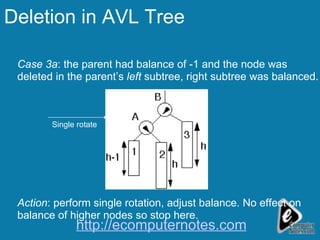
Deletion in AVL Tree Case 3a : the parent had balance of -1 and the node was deleted in the parent’s  left  subtree, right subtree was balanced. Action : perform single rotation, adjust balance. No effect on balance of higher nodes so stop here. Single rotate http://ecomputernotes.com
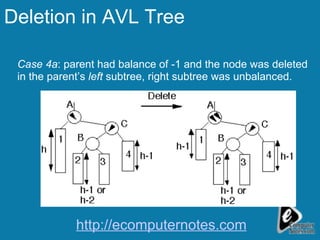
Deletion in AVL Tree Case 4a : parent had balance of -1 and the node was deleted in the parent’s  left  subtree, right subtree was unbalanced. http://ecomputernotes.com
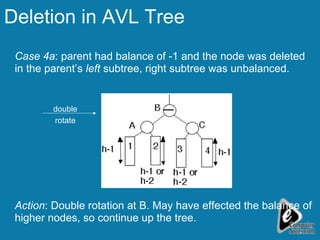
Deletion in AVL Tree Case 4a : parent had balance of -1 and the node was deleted in the parent’s  left  subtree, right subtree was unbalanced. Action : Double rotation at B. May have effected the balance of higher nodes, so continue up the tree. rotate double
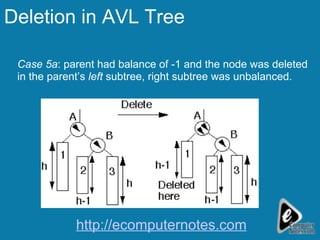
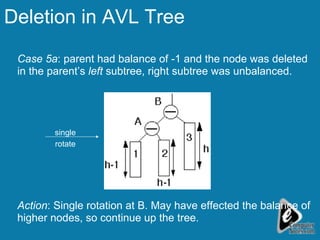
Deletion in AVL Tree Case 5a : parent had balance of -1 and the node was deleted in the parent’s  left  subtree, right subtree was unbalanced. http://ecomputernotes.com
Deletion in AVL Tree Case 5a : parent had balance of -1 and the node was deleted in the parent’s  left  subtree, right subtree was unbalanced. Action : Single rotation at B. May have effected the balance of higher nodes, so continue up the tree. rotate single
Other Uses of Binary Trees Expression Trees http://ecomputernotes.com
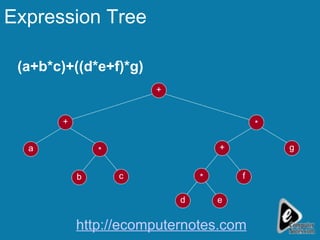
Expression Trees Expression trees , and the more general parse trees and abstract syntax trees are significant components of compilers. Let us consider the expression tree. http://ecomputernotes.com
Expression Tree (a+b*c)+((d*e+f)*g) a c + b g * + + d * * e f http://ecomputernotes.com
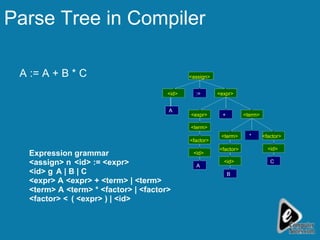
Parse Tree in Compiler Expression grammar <assign>  <id> := <expr> <id>  A | B | C <expr>  <expr> + <term> | <term> <term>  <term> * <factor> | <factor>  <factor>  ( <expr> ) | <id> <assign> <id> <expr> <expr> <term> <term> <term> <factor> C B * + <id> <id> A := A <id> <factor> <factor> A := A + B * C
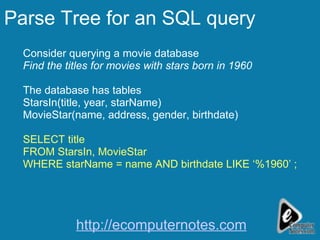
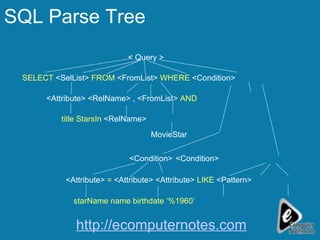
Parse Tree for an SQL query Consider querying a movie database Find the titles for movies with stars born in 1960 The database has tables StarsIn(title, year, starName) MovieStar(name, address, gender, birthdate) SELECT title FROM StarsIn, MovieStar WHERE starName = name AND birthdate LIKE ‘%1960’ ; http://ecomputernotes.com
SQL Parse Tree < Query > SELECT  <SelList>  FROM  <FromList>  WHERE  <Condition> <Attribute> <RelName> , <FromList>  AND title   StarsIn  <RelName>  <Condition>   <Condition> <Attribute>  =  <Attribute> <Attribute>  LIKE  <Pattern> starName name birthdate ‘%1960’ MovieStar http://ecomputernotes.com
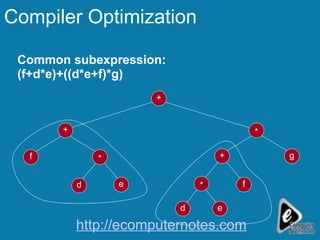
Compiler Optimization Common subexpression: (f+d*e)+((d*e+f)*g) f e + d g * + + d * * e f http://ecomputernotes.com
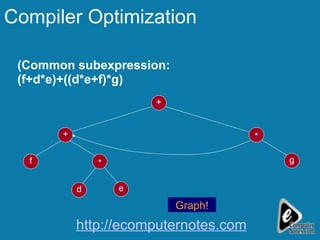
Compiler Optimization (Common subexpression: (f+d*e)+((d*e+f)*g) f e + d g * + * Graph! http://ecomputernotes.com

computer notes - Data Structures - 22

  • 1.
    Class No.22 Data Structures http://ecomputernotes.com
  • 2.
    Deletion in AVLTree There are 5 cases to consider. Let us go through the cases graphically and determine what action to take. We will not develop the C++ code for deleteNode in AVL tree. This will be left as an exercise. http://ecomputernotes.com
  • 3.
    Deletion in AVLTree Case 1a : the parent of the deleted node had a balance of 0 and the node was deleted in the parent’s left subtree. Action : change the balance of the parent node and stop. No further effect on balance of any higher node. Delete on this side http://ecomputernotes.com
  • 4.
    Deletion in AVLTree Here is why; the height of left tree does not change. 1 2 3 4 5 6 7 0 1 2 http://ecomputernotes.com
  • 5.
    Deletion in AVLTree Here is why; the height of left tree does not change. 1 2 3 4 5 6 7 2 3 4 5 6 7 0 1 2 remove(1) http://ecomputernotes.com
  • 6.
    Deletion in AVLTree Case 1b : the parent of the deleted node had a balance of 0 and the node was deleted in the parent’s right subtree. Action : (same as 1a ) change the balance of the parent node and stop. No further effect on balance of any higher node. Delete on this side http://ecomputernotes.com
  • 7.
    Deletion in AVLTree Case 2a : the parent of the deleted node had a balance of 1 and the node was deleted in the parent’s left subtree. Action : change the balance of the parent node. May have caused imbalance in higher nodes so continue up the tree. Delete on this side http://ecomputernotes.com
  • 8.
    Deletion in AVLTree Case 2b : the parent of the deleted node had a balance of -1 and the node was deleted in the parent’s right subtree. Action : same as 2a: change the balance of the parent node. May have caused imbalance in higher nodes so continue up the tree. Delete on this side http://ecomputernotes.com
  • 9.
    Deletion in AVLTree Case 3a : the parent had balance of -1 and the node was deleted in the parent’s left subtree, right subtree was balanced. http://ecomputernotes.com
  • 10.
    Deletion in AVLTree Case 3a : the parent had balance of -1 and the node was deleted in the parent’s left subtree, right subtree was balanced. Action : perform single rotation, adjust balance. No effect on balance of higher nodes so stop here. Single rotate http://ecomputernotes.com
  • 11.
    Deletion in AVLTree Case 4a : parent had balance of -1 and the node was deleted in the parent’s left subtree, right subtree was unbalanced. http://ecomputernotes.com
  • 12.
    Deletion in AVLTree Case 4a : parent had balance of -1 and the node was deleted in the parent’s left subtree, right subtree was unbalanced. Action : Double rotation at B. May have effected the balance of higher nodes, so continue up the tree. rotate double
  • 13.
    Deletion in AVLTree Case 5a : parent had balance of -1 and the node was deleted in the parent’s left subtree, right subtree was unbalanced. http://ecomputernotes.com
  • 14.
    Deletion in AVLTree Case 5a : parent had balance of -1 and the node was deleted in the parent’s left subtree, right subtree was unbalanced. Action : Single rotation at B. May have effected the balance of higher nodes, so continue up the tree. rotate single
  • 15.
    Other Uses ofBinary Trees Expression Trees http://ecomputernotes.com
  • 16.
    Expression Trees Expressiontrees , and the more general parse trees and abstract syntax trees are significant components of compilers. Let us consider the expression tree. http://ecomputernotes.com
  • 17.
    Expression Tree (a+b*c)+((d*e+f)*g)a c + b g * + + d * * e f http://ecomputernotes.com
  • 18.
    Parse Tree inCompiler Expression grammar <assign>  <id> := <expr> <id>  A | B | C <expr>  <expr> + <term> | <term> <term>  <term> * <factor> | <factor> <factor>  ( <expr> ) | <id> <assign> <id> <expr> <expr> <term> <term> <term> <factor> C B * + <id> <id> A := A <id> <factor> <factor> A := A + B * C
  • 19.
    Parse Tree foran SQL query Consider querying a movie database Find the titles for movies with stars born in 1960 The database has tables StarsIn(title, year, starName) MovieStar(name, address, gender, birthdate) SELECT title FROM StarsIn, MovieStar WHERE starName = name AND birthdate LIKE ‘%1960’ ; http://ecomputernotes.com
  • 20.
    SQL Parse Tree< Query > SELECT <SelList> FROM <FromList> WHERE <Condition> <Attribute> <RelName> , <FromList> AND title StarsIn <RelName> <Condition> <Condition> <Attribute> = <Attribute> <Attribute> LIKE <Pattern> starName name birthdate ‘%1960’ MovieStar http://ecomputernotes.com
  • 21.
    Compiler Optimization Commonsubexpression: (f+d*e)+((d*e+f)*g) f e + d g * + + d * * e f http://ecomputernotes.com
  • 22.
    Compiler Optimization (Commonsubexpression: (f+d*e)+((d*e+f)*g) f e + d g * + * Graph! http://ecomputernotes.com

Editor's Notes

  • #4 Start of lecture 24
  • #8 End of lecture 23.
  • #23 End of lecture 24.